All Day Event Report
Wednesday 22nd July 2026
All Day Event Photos for Wednesday 22nd July 2026 - Guest Demonstrator: Colwin Way
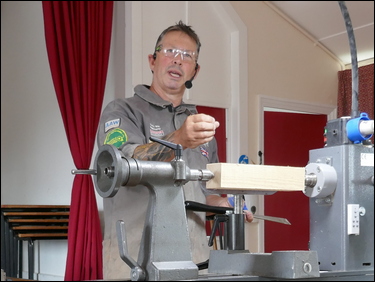
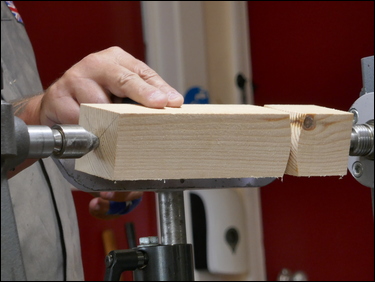
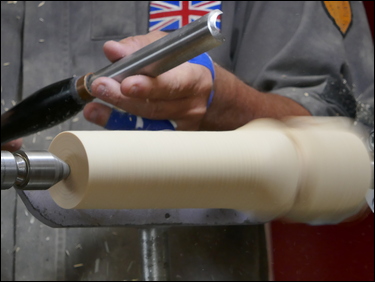
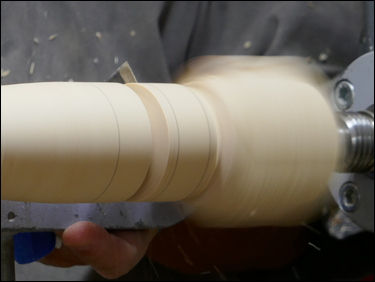
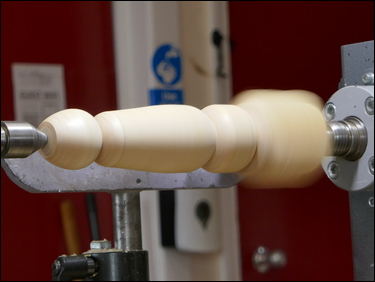
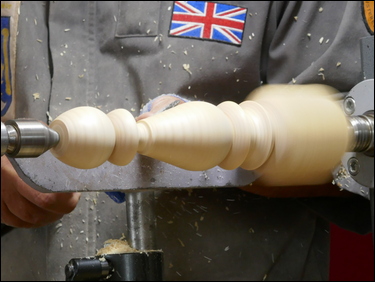
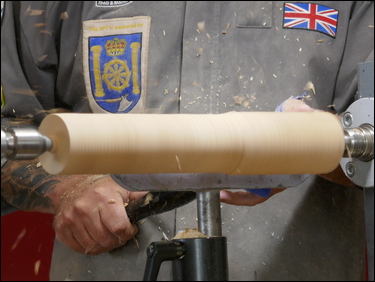
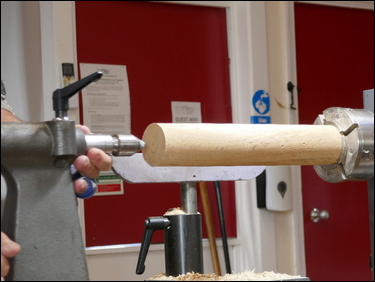
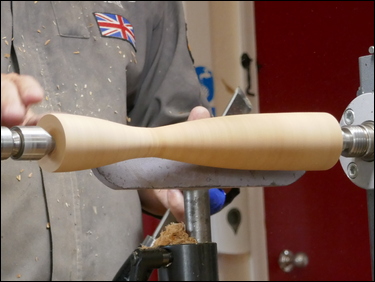
Today's all-day, extended demonstration was presented by Colwin Way (Website: www.colwinwaywoodturner.com). An internationally recognised woodturner and demonstrator - Colwin specializes in both traditional and contemporary turning, creating everything from functional pieces to artistic designs. His passion for the craft is evident in his ability to break down complex techniques - making woodturning accessible to beginners and experienced turners alike.Colwin started the day with a 'warm-up session' using the skew chisel. He recommended this as a way to start your woodturning day with a 5-to-10-minute exercise - to get you in the zone! Using a piece of 2 inches square by 12 inches long softwood - he proposed the making of a small table leg to cover all of the skew chisel cuts. Held between centres, the pommel cut (square to round) was cut first - using curved 'V' cuts. A spindle roughing gouge was used to turn the square to round - and skew chisel planing cuts to make it smooth. The techniques for making 'V' cuts and multiple beads with the skew was shown - along with coves cut with a spindle gouge and a bowl gouge.
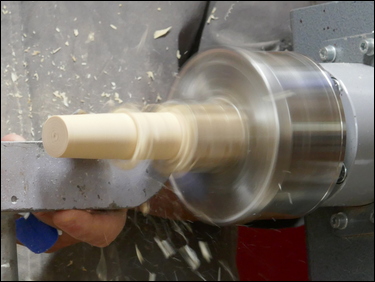
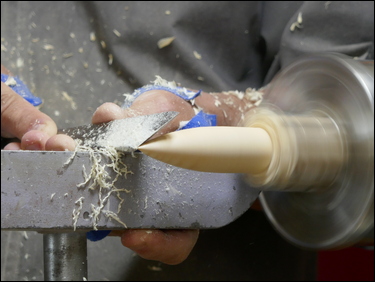
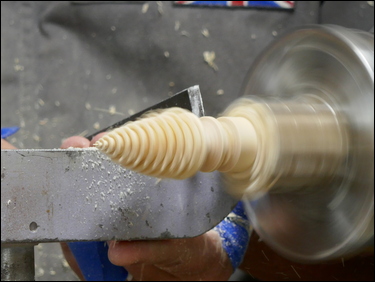
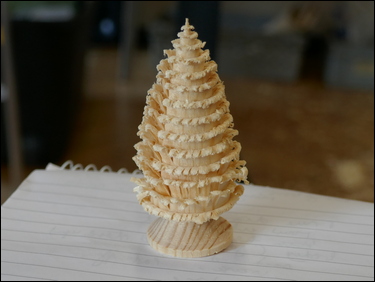
Colwin's next item was a small Christmas tree - cut entirely with a skew. A small piece of square stock was held in pin jaws and cut to round - then to a curved cone shape ending with a sharp point. Then, using the heel (short point) of the skew, Colwin proceeded to cut a series of short 'curls' along the length of the wood - working from the headstock end to the tailstock. The base was finished and parted off.
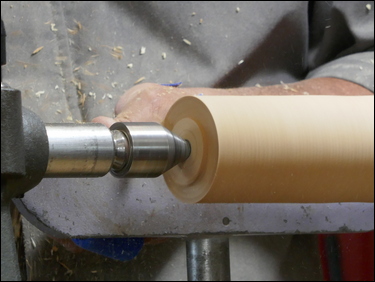
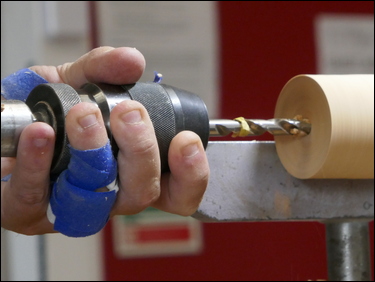
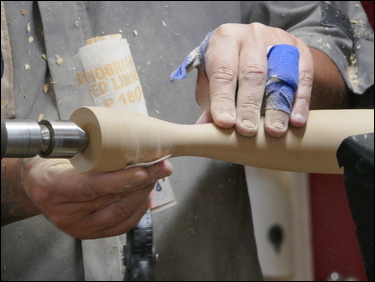
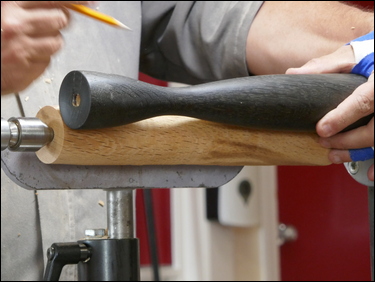
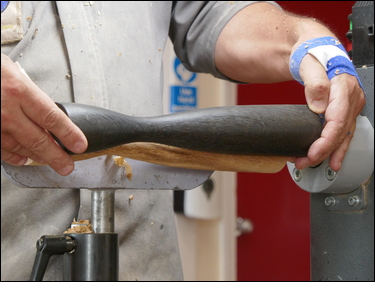
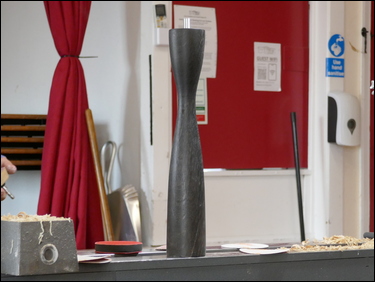
The next project was the making of a pair of candlesticks in the style of Rude Osolnik. Made in wet, brown oak from blanks that were approx. 2.5 inches square by 15 inches long. Both parts were initially held between centres, roughed to round and the ends were cleaned up. A 4-jaw chuck with 'C' jaws was mounted - the part was held in the chuck, the end face was cleaned up and a 10 mm diameter by 15 mm deep hole was drilled in the end face (on both items).
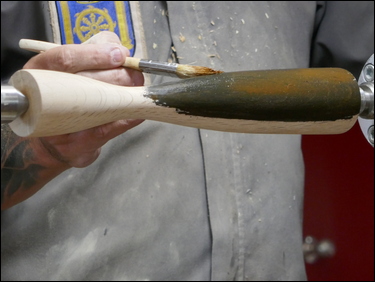
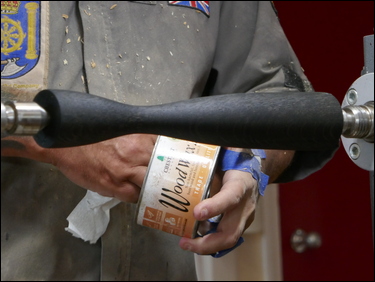
The part was again held between centres and the shape of the candlestick was turned with a spindle roughing gouge, finished with a skew and sanded through the grits. The part was then stained/ ebonised with a wire wool and vinegar mix - a coating of wax to enhance the medullary rays was used as a finish.
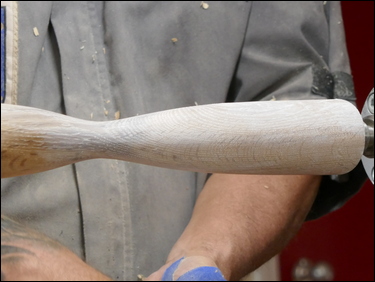
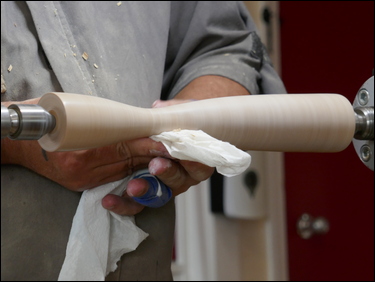
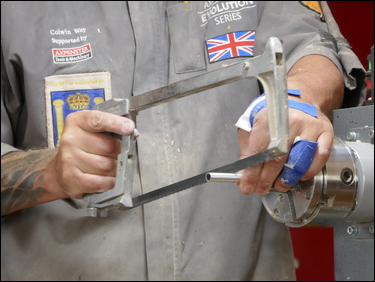
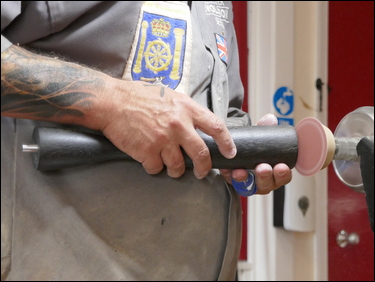
The second candlestick was re-mounted between the centres. Colwin roughed and finished the shape by 'eye' - comparing the second one to the already finished one. Calipers can be used as necessary to size the diameters. After sanding, the part was wire-brushed along its length to open up the grain. A coating of liming wax was pushed into the grain, a handful of shavings was used to remove the surplus and tissue was used to polish the part. The candle-holder was made from a section of 10 mm diameter aluminium tube, that was held in a chuck and polished via sanding on the lathe, to brighten the surface - before being cut to length. The tube was tapped into the candlestick and the base was finished sanded via a sanding pad held in the chuck, to complete the part.
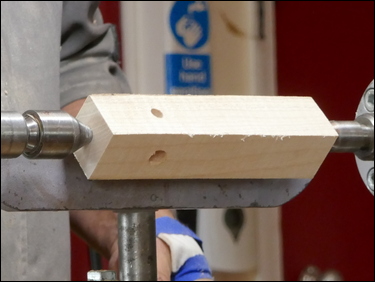
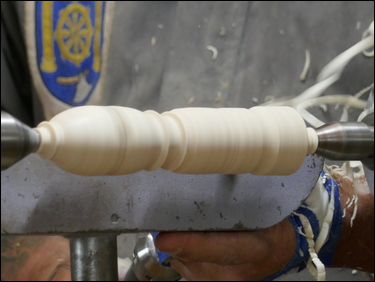
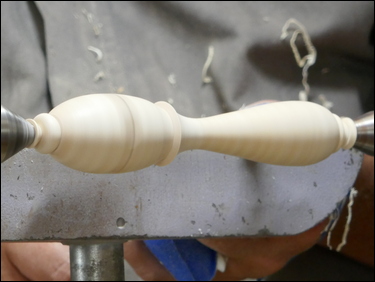
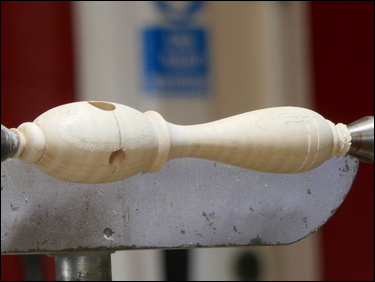
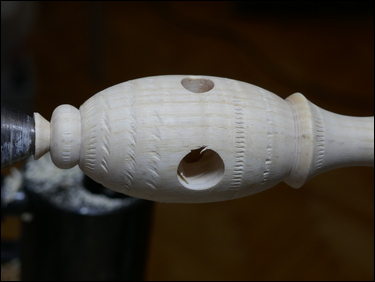
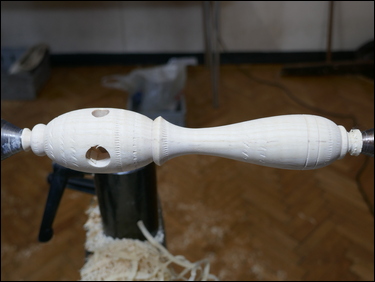
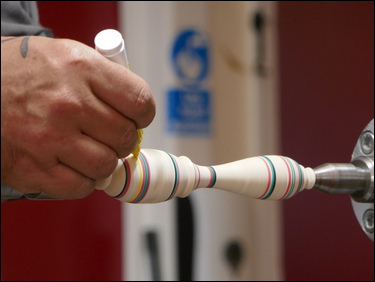
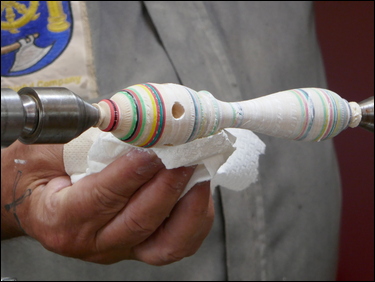
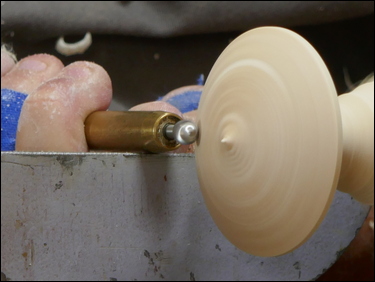
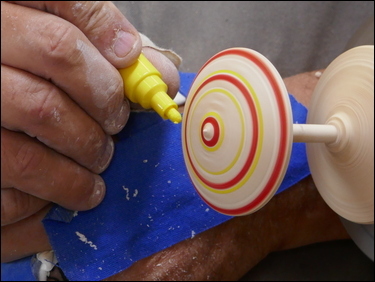
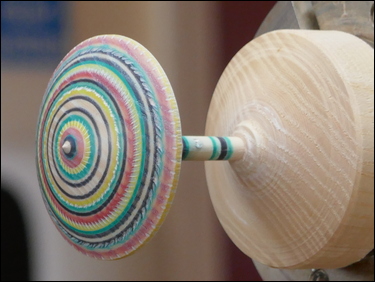
The next project was a two-piece spinning top comprising a handle and the spinner. Starting with the handle - an ash blank 1.25 inches square by 7 inches long had been pre-prepared with the drilling of two holes - 12 mm and 9 mm diameter - accurately drilled at right-angles to each other in the centre of the blank - approx. 1.25 inches from the end. The part was held between centres, roughed to round and finish turned with skew chisel and spindle gouge. The part was textured with a Henry Taylor Decorating Elf and a Crown Mini Spiralling Tool. The part was decorated using various coloured felt tip pens - and finished with liming wax. The ends were cut off and sanded smooth.
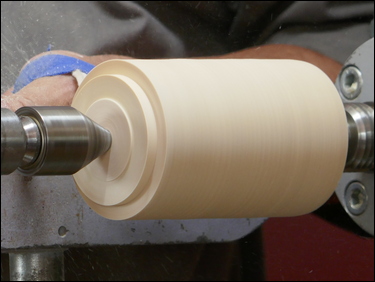
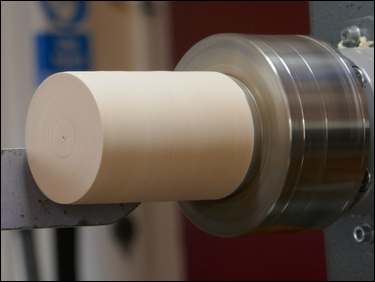
The spinner was made from an ash blank 3 inches square by 4 inches long. Starting with the part held between centres, it was roughed to round and a tenon cut at the tailstock end. The part was then held in a chuck via 'C' jaws on the tenon. The spinner was then shaped - starting with the tapered end - turned to a sharp point and then some shaping behind the 'head' of the spinner was carried out. The front of the spinner was textured as before - then the spindle section was completed - to 8 mm diameter. A 3.5 mm diameter hole was drilled through the spindle for the 'pull cord'. Once again, colour was added via felt tip pens, along with the application of liming wax. The spinner was parted off. Assemble the spinner into the handle - thread the pull cord into the small hole (via the 12 mm diameter hole in the handle) - wind it up - and pull!
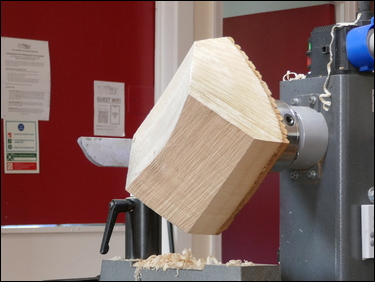
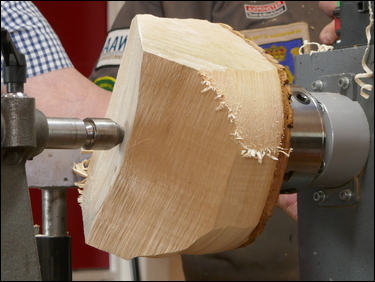
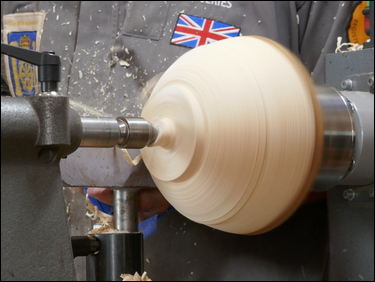
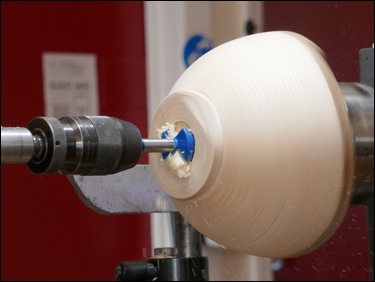
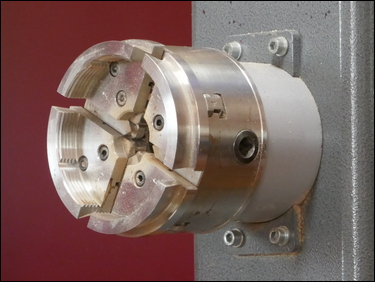
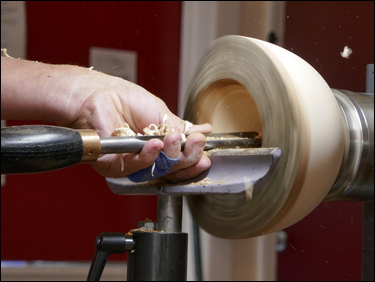
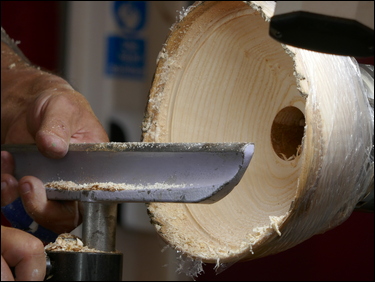
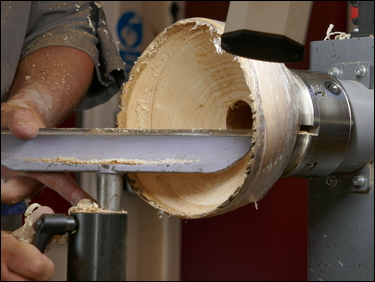
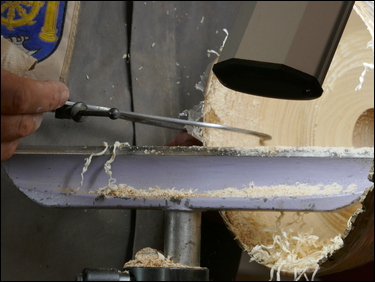
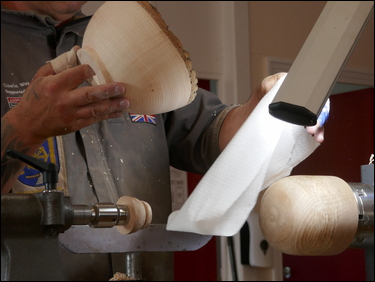
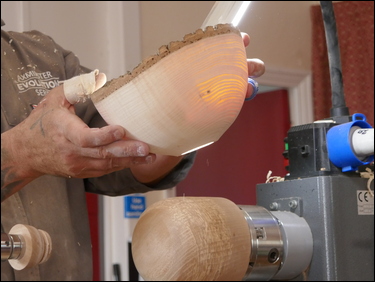
Colwin's final project for the day was the making of a thin-wall lampshade. The blank was a large chunk of very wet ash measuring approx. 10 inches diameter by 7 inches long - which had been pre-prepared with a mounting hole in the bark side for pin-jaws. The blank was mounted on the chuck - with tailstock support. The outside shape of the lampshade was roughed out with a large bowl gouge - a foot was turned to suit the large gripper jaws. The outside was shear cut with the bowl gouge to finish and then power sanded through the grits. A 42 mm diameter Forstner bit was used to drill the lampshade to suit the lamp holder.
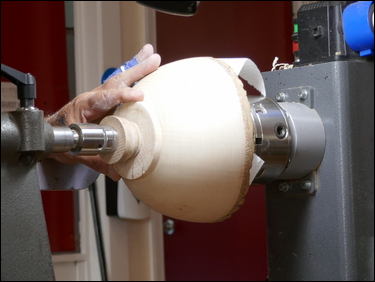
The lampshade was reversed onto the tenon in the gripper jaws - and the inside of the 'bowl' was gradually hollowed - aiming for a 3 mm thick wall - and a little thicker at what would be the top of the lampshade. The consistency of the wall thickness was checked via calipers and by shining a light through it from the inside.
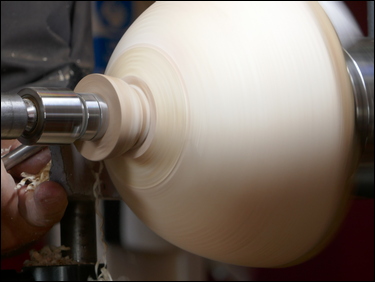
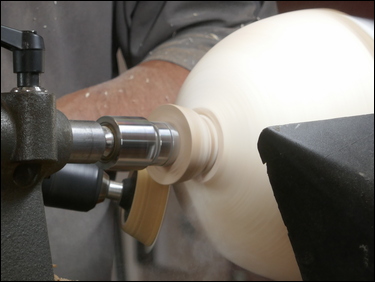
To complete the turning, the lampshade was mounted on a large dome shaped pommel - protected with a strip of kitchen paper and supported by a custom shaped bung (in the 42 mm diameter hole) mounted on the tailstock centre. The tenon was carefully turned away - blended into the outside shape and power sanded. The completed lampshade could be treated with coats of finishing oil.
Today, Colwin served us to a very varied and entertaining display of superb, precision woodturning skills and techniques, along with a constant stream of hints, tips, observations and amusing stories. A range of attractive items were completed - something for everyone!
Thank you Colwin!
 |
 |
 |
 |
 |
 |
 |
 |
 |
 |
 |
 |
 |
 |
 |
 |
 |
 |
 |
 |
 |
 |
 |
 |
 |
 |
 |
 |
 |
 |
 |
 |
 |
 |
 |
 |
 |
 |
 |
 |
 |
 |
 |
 |
 |
 |
 |
 |
 |
 |
 |
 |